
“An affix is a linguistic or physical element attached to something else. It generally refers to a letter or group of letters added to a root word to change its meaning, or the physical act of sticking or fastening one object to another” – Merriam Webster
A productive affix is one that can still be slapped onto new bases to make new words people actually understand on first hearing, the way -ness turns almost any adjective into a noun without thinking twice about it. An unproductive one is basically frozen, stuck in the handful of words it already built, unable to extend to anything new. Internet slang has turned this whole spectrum into something you can watch happen in real time, which traditional morphology was never really built to keep up with.
In a linguistic course, I was recently asked to review the “common” affixes: un-, -ish, -esque, and -ion. Upon drafting my response, I couldn’t help but notice how completely detached these textbook definitions feel from the way we actually communicate online.
Take un-. It used to be the default way to negate a verb, and it still works, technically, but I’d argue de- and anti- have taken over its job in digital culture. Nobody says “uninfluence.” They say deinfluence, the trend of telling people not to buy something, and it sits right next to anti-haul, which does the same work without bothering with un- at all. The prefix isn’t dead, but it’s lost the cultural foothold it used to have as the default negation, the same way -wise sat around mostly unproductive for decades until internet shorthand revived it a little.
Meanwhile -ish is thriving in a way that feels uncontested to everything else on this list. It can attach to basically anything and instantly soften it into a vibe instead of a fact: effectiveish, lateish, fineish. It doesn’t even require the base word to make total sense first. That’s productivity in its purest form, a rule flexible enough that you could coin a new one right now and a stranger would understand it immediately.
-esque is doing something a little different. While it’s productive, its use-case has concentrated under a sole, specific register; comparing something to a famous person or vibe. Wes Anderson-esque, Tarantino-esque. It carries a prestige that -ish never secured. You wouldn’t say “Kendrick-ish.” The two suffixes are doing adjacent jobs but they come with completely different social weights attached.
And then there’s -ion, which I’d call basically unproductive at this point, at least outside of formal or academic contexts. Nobody is out here generating new -ion words for internet trends. What’s actually happening is -ification has slid into that semantic space instead: brain-rot-ification, kirkification, whatever-ification you need on a given week. It’s clunkier, longer, and somehow that’s part of the appeal, like the extra syllables are doing comedic work that the sleeker -ion never could.
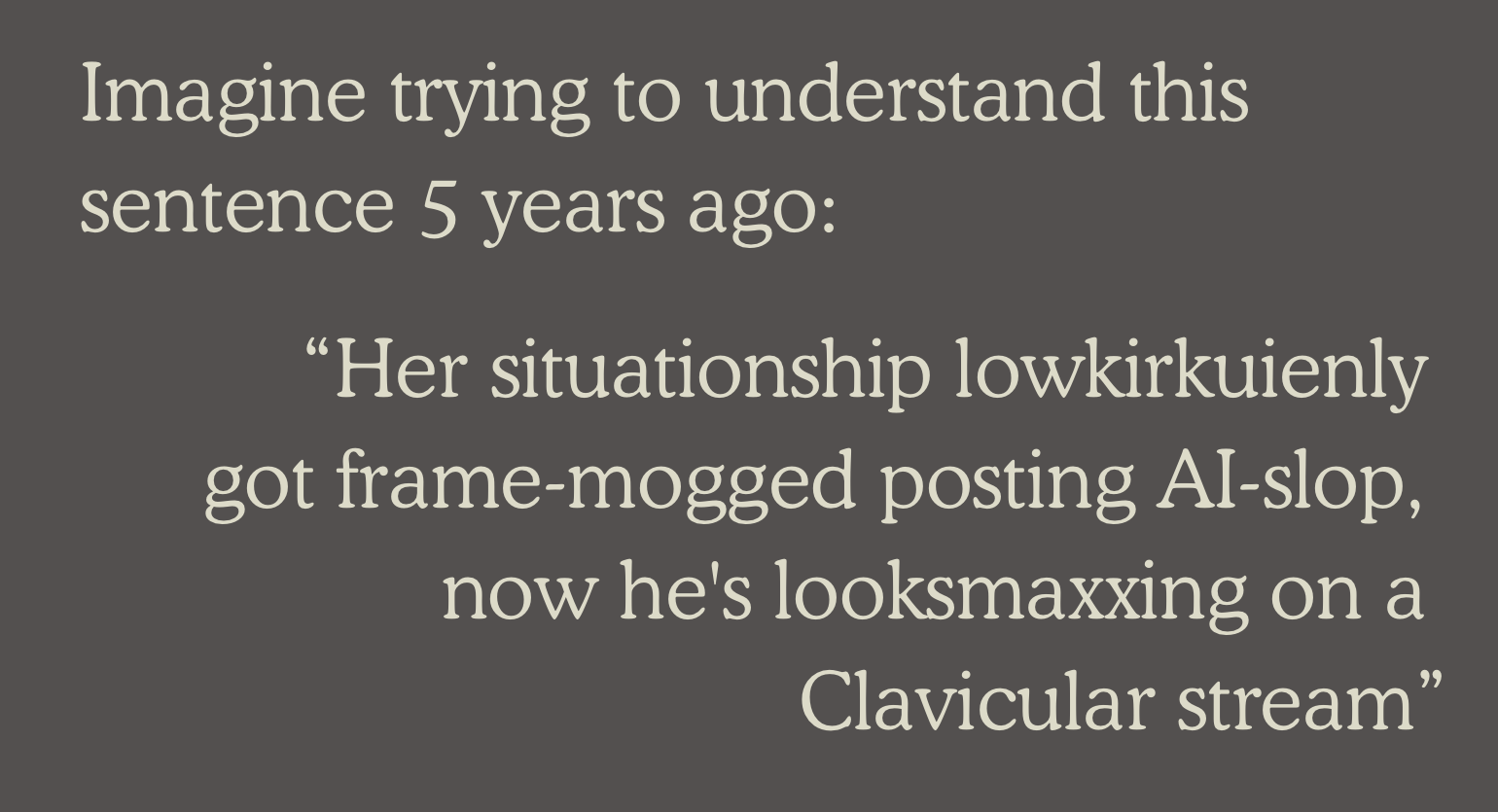
What’s actually interesting to me isn’t just which affixes are winning, but how fast the whole system cycles. Slang morphology moves at a pace traditional word formation was never designed for, because the entire incentive structure is different. A dictionary entry is supposed to mean a word has staying power. A slang affix is supposed to mean a word is funny or sharp right now, with the understanding that “right now” might only last a few weeks. -maxxing showed up everywhere, looksmaxxing, unemployment-maxxing, larp-maxxing, all variations on the same idea of optimizing something to its absolute limit, often satirically. -ship gave us situationship, a single word that somehow captures an entire category of modern relationship ambiguity that didn’t have a name before. More interestingly, the -tuation- from the original “situation” has seemingly added itself to its associated suffix through the linguistic phenomenon of secretion, latching onto -ship to form even more jumbled phrases such as “schitzuationship” or “textuationship.” Then there’s -slop which is ugly on purpose, ai-slop, bowl-slop, content-slop, doing the work of signaling contempt for mass-produced anything, ironically leaving us with word-slop, the fast-fashion-ification of a cultural lexicon.
None of these are going to outlast the trend cycle that produced them, and that’s sort of the point. Productivity used to be measured across decades. Online, it gets measured in weeks, sometimes days, and a suffix can go from novel to “over” to nostalgic before even UrbanDictionary is informed. The concept is nothing new, it is neologisms working exactly the way they were intended, just running at the speed digital culture demands instead of the speed print culture permitted. We get to witness linguistic evolution happen in real-time, proving that words don’t need to last forever to mean something right now. It serves as proof that human expression will always adapt to run at the exact speed of the culture driving it.


Leave a comment