
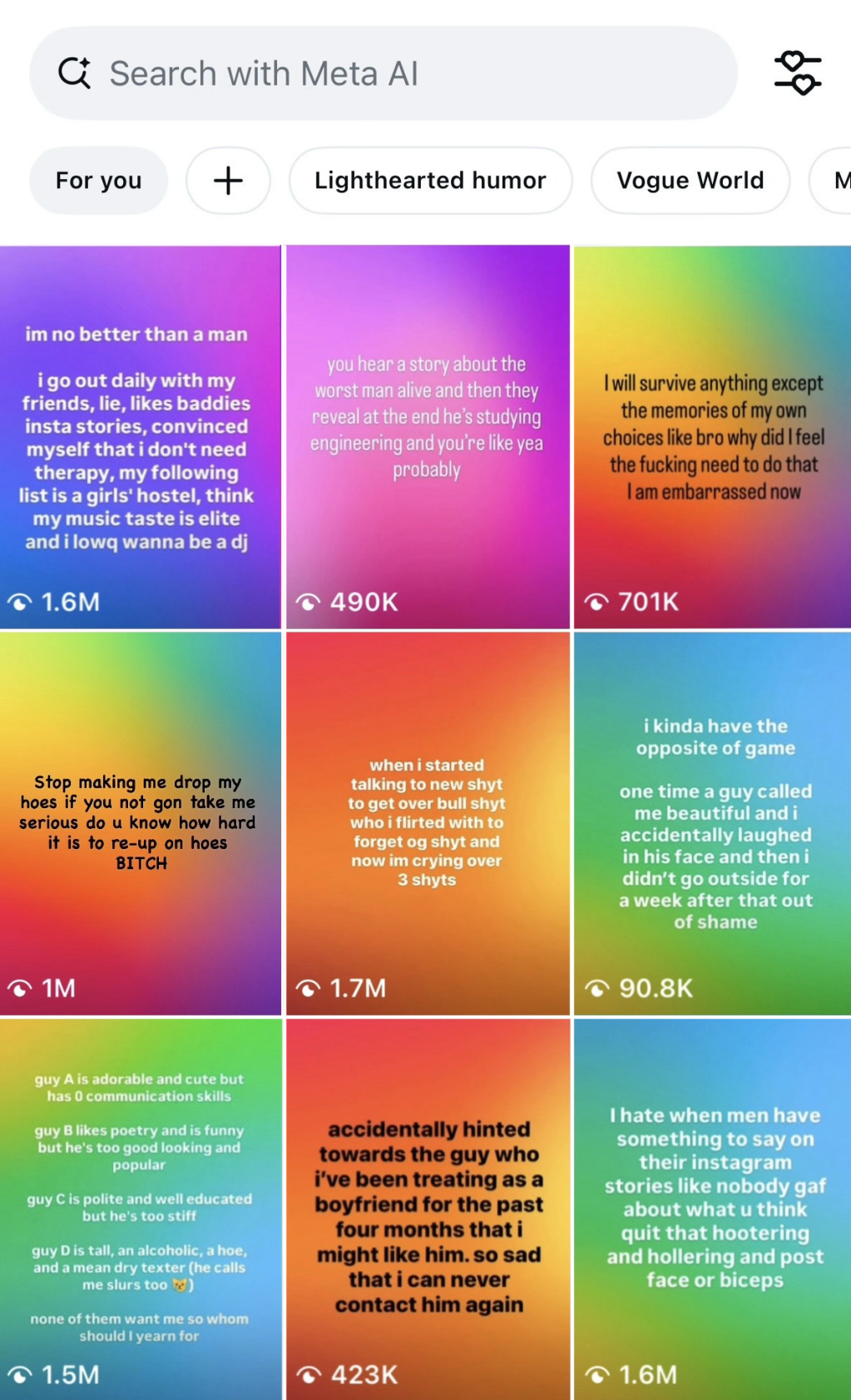
Every Instagram Reel has seemingly turned into short, witty text snippets declaring a hatred for the modern dating with a distinct sense of certainty and nihilism. Scrolling social media in a digital sphere infested with unseen levels of avoidance made me question whether anyone actually likes relationships anymore, but I think the problem is much deeper than mere dissatisfaction. It’s the damn phones.
A lengthy email sits in your inbox. You skim as some mildly concerning words jump out, distracting almost. You restart the mental scan. Ohh a notification from TikTok! Impatience floods your senses, waiting to once again hit the dopamine stream you spent the whole morning drowning in. You screenshot the email and ask your handy generative ai to sum it up and offer a sample response. What’s the harm in that?
Your roommate joins you in the kitchen. “Can we talk?” Your stomach drops. The eye contact, the demand of a real-time response, no comfort of a rough draft. You half-listen while your hand finds your phone in your pocket, maybe just to feel, or maybe to glance at the weather in Cupertino. She’s saying something about how she’s been feeling excluded. “Yeah, totally, I hear you,” and you mean it, at least you want to mean it, but you’re mostly mentally drafting the apology text you’ll send later instead. It’s easier that way.
You can look past this events, write them off as one-time conveniences allowing you to place your efforts into more important demands. But each over simplification of communication chips away at your tools of interaction. The opportunity cost of learned experience starts to feel more like a massive debt. You don’t notice it accruing until you’re standing in a kitchen with nothing to say.
The tragedy of those nihilistic dating Reels is not that people have stopped wanting love, only they’ve lost the stomach for the parts of love that requires real effort without the cushioning of a consistent algorithm and immediate feedback.
The rise of AI is diminishing our ability to handle complex emotions, and avoidance in relationship conflict is no different. We are witnessing communication between human beings who are less and less capable of describing their own feelings. We get visibly frustrated when the short sentence fragments we could easily offload to an AI don’t quite compute to a living, breathing person who is opinionated and layered.
When you are used to a machine that accurately predicts your next word, interacting with a human who defies prediction is a frustrating feat. This has bred a general impatience and a profound lack of capacity to work through conflict. If an app lags for more than two seconds, we close it. That same low-tolerance threshold has bled into our conversations, leaving us to suffer from a chronic reliance on the proverbial “skip 10 seconds” button. We yearn for resolution without being willing to work through the present.
This total intolerance for relational friction has culminated in the ultimate form of avoidance: a massive exodus from the dating pool altogether. People are increasingly deciding they would simply rather not date, period. When our daily lives are engineered to be friction-free, the high-stakes vulnerability of pursuing someone else feels less like an exciting risk and more like an unnecessary chore. Why download the apps, navigate the exhausting small talk, and risk the inevitable sting of rejection or conflict when you can simply opt out? By declaring oneself “done with dating,” the threat of emotional discomfort is instantly neutralized. It’s the ultimate manifestation of the avoidance epidemic.
Additionally, there is seemingly less value being placed on real connection when niche social media algorithms can feel so para-socially-interpersonal. We spend hours in comment sections on deeply specific internet lore that has been tailored perfectly for our exact psychological makeup based of data that’s been accumulating for years. The algorithm curates content checking each box of your niches the way no real human with their own sense of preference could ever replicate. It is hard to realize you’re alone when so many users, so similar to yourself, appear to be pixels away.
When the internet mirrors your mind perfectly, a real relationship feels like a bad user experience. But a curated feed will never text you back when you’re lonely, and an AI-generated apology won’t save a friendship on the kitchen floor. What used to be a protective wall built in real relationships is now something we are actively cultivating in everyone, on purpose, by design.


Leave a comment